Brown-Forsythe Test of Homogeneity of Variances
Source:R/Brown_Forsythe_test.R
Brown_Forsythe_test.RdPerforms Brown-Forsythe test to assess the null hypothesis that the variances are equal across all groups (samples) defined by the independent variable.
Arguments
- data
A data frame containing the variables specified in the formula.
- formula
A formula of the form
DV ~ IV, whereDVis the dependent (response) variable andIVis the independent (grouping) variable.- alpha
A numeric value specifying the significance level. Must be between 0 and 1. Default is 0.05.
- silent
A logical value. If
FALSE(default), results are printed to the console. IfTRUE, no output is printed.- summary
A logical value (default:
FALSE). IfTRUE, a summary table for the input data is returned.- misc
A logical value. If
FALSE(default), only essential parameters are returned. IfTRUE, additional auxiliary parameters are included in the output.- transform
A function used to transform the response variable into deviations from a specified location measure.
- method
A character specifying either
"MBF"(default) or"BF".
Value
A list containing the test statistics, p-value, degrees of freedom,
and optionally a summary table and/or auxiliary parameters,
depending on the values of summary and misc.
Details
transform
The concept is similar to ANOVA procedure (transform the response variable to
residuals before analysis). Possible transformation are:
y' = |yi - ybar| (default)
y' = (yi - ybar) ^ 2
y' = ln((yi - ybar) ^ 2)
y' = sqrt(|yi - ybar|)
The ybar could be either mean, median (default), or trimmed-mean.
method
"BF": The original Brown–Forsythe test proposed by Brown and Forsythe (1974), a modification of Levene's test that uses the median instead of the mean."MBF"The modified Brown–Forsythe test proposed by Mehrotra (1997), which adjusts the degrees of freedom and consequently yields an approximate F-distribution of F(f1, f2) rather than F(k - 1, N - k). Compared with the original version (BF), this modification tends to reduce the Type I error rate at the cost of a higher Type II error rate.
References
Brown, M. B., & Forsythe, A. B. (1974). Robust tests for the equality of variances. Journal of the American Statistical Association, 69(346), 364–367. https://doi.org/10.1080/01621459.1974.10482955
Mehrotra, D. V. (1997). Improving the Brown–Forsythe solution to the generalized Behrens–Fisher problem. Communications in Statistics—Simulation and Computation, 26, 1139–1145. https://doi.org/10.1080/03610919708813431
Examples
df0 <- roGFP[[1]]
out <- Brown_Forsythe_test(df0, ro ~ grp)
#>
#> --------------------------------------------
#> Brown-Forsythe homogeneity of variance test
#>
#> Response: ro
#>
#>              DF   SS   MS Fvalue  pvalue
#> Group      1.96 0.01 0.01 3.9769 0.02918
#> Residuals 32.86 0.05    0
#> Total     34.81 0.06
#>
#> #> Group variances are unequal.
#> --------------------------------------------
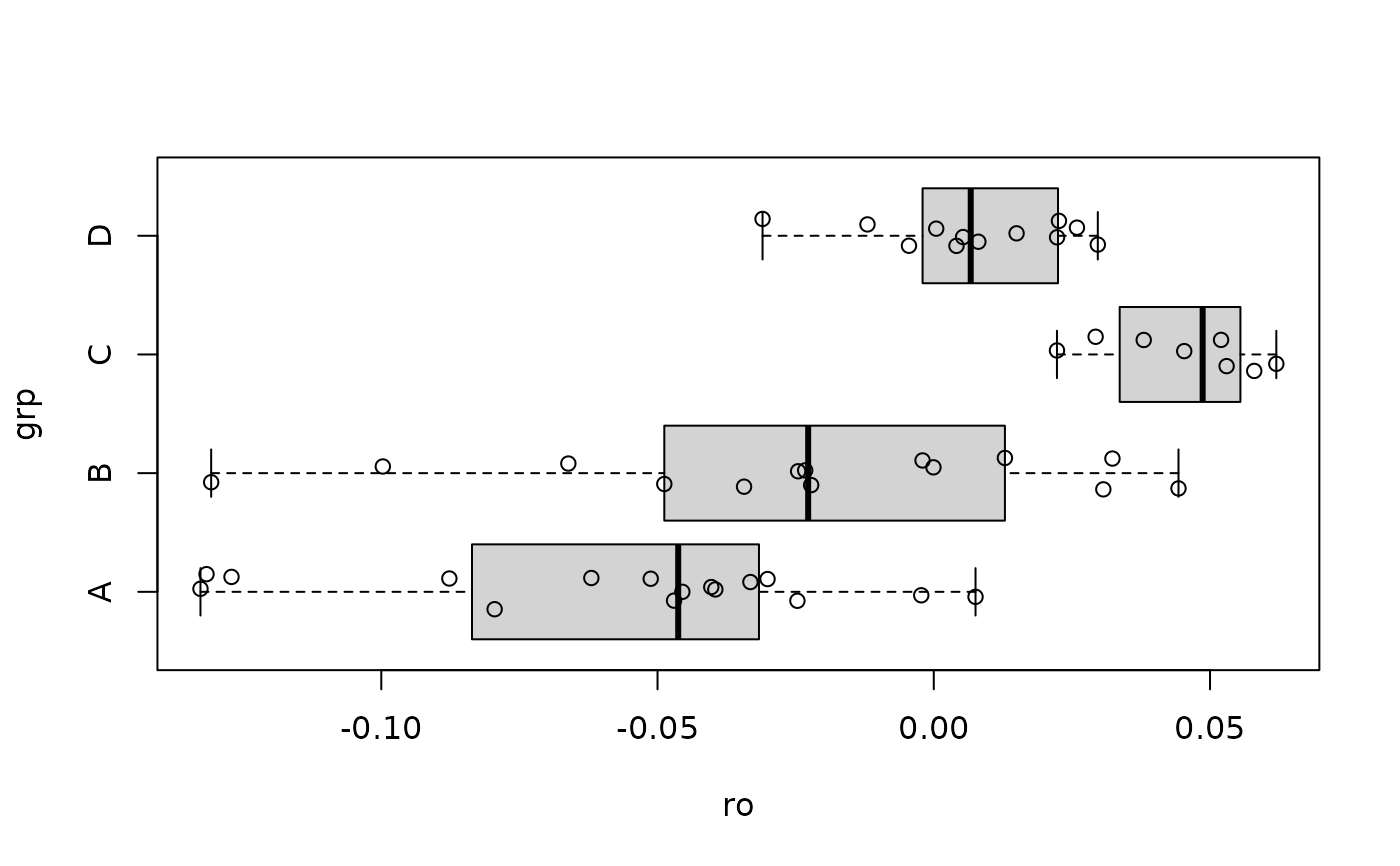
boxplot(ro ~ grp, df0, horizontal = TRUE)
points(x = df0$ro, y = jitter(as.numeric(df0$grp), amount = 0.15))